Now Arriving at Moynihan Train Hall
As travelers fill the new skylit concourse, we trace the history of the station that’s become an emblem of New York’s recovery.
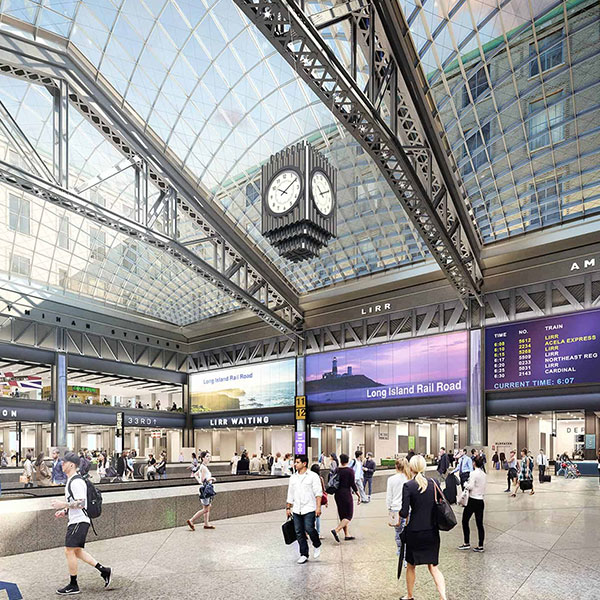
With the heat and humidity rising, many New Yorkers are continuing a time-honored summer ritual: getting out of town. At the same time, while tourism is still far its pre-pandemic levels, a trickle of vacationing visitors has begun to reanimate the city. As a result, the scene at Penn Station has lately begun to resemble the eclectic mix of people that once thronged the city’s busiest transit hub: local commuters, urbanites making a weekend escape, and tourists from near and far.
Now instead of the old, dingy underground waiting areas at Penn Station, these travelers gather beneath a soaring skylight that has already become a source of civic pride, even a symbol for the optimism of this moment. As Amtrak trains approach the station, conductors make a new announcement:
“Next and last stop: New York City, Moynihan Train Hall.”
What did it take to complete this journey?
Conceived decades ago as a solution to ease overcrowding and to help correct a monumental urban planning mistake, Moynihan Train Hall is transforming the travel experience for thousands of Long Island Rail Road and Amtrak riders. The demolition of McKim, Mead & White’s original Pennsylvania Station in the mid-1960s was experienced as a tragic loss for the city — so much so that it helped garner widespread support for the New York City Landmarks Law. Thankfully, another massive McKim, Mead & White building sat underused across the street: the James A. Farley Post Office Building.
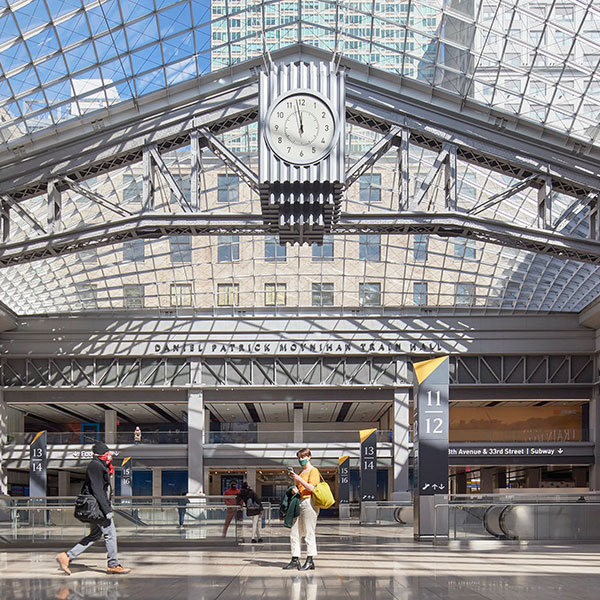
In the 1990s, with the new Penn Station struggling to accommodate (let alone inspire) its users, United States Senator Daniel Patrick Moynihan put forward the vision to convert the post office into a spacious train hall that would evoke the grandeur of the original station. At the end of the decade, President Bill Clinton helped unveil SOM’s first crack at reconfiguring the historic building. After that proposal failed to materialize, SOM provided an updated concept as part of a public-private partnership led by Empire State Development in 2006. And then in 2016, SOM was part of the team that submitted a winning proposal, together with Skanska, The Related Companies, and Vornado Realty Trust.
The third time, as they say, is the charm. Senator Moynihan did not live to see his vision fulfilled, but with this reimagined landmark building now named after him, his contributions will not be forgotten. And there’s even more for New York’s train commuters to celebrate: Penn Station’s new East End Gateway, also designed by SOM, is now open as well. While less publicized than Moynihan Train Hall, it is nonetheless a big deal — delivering a dramatic and modern front-door identity along Seventh Avenue for the much-maligned station. Higher ceilings, new wayfinding signage, and improved access and circulation will give commuters easier access to the LIRR and subway.
It has taken multiple presidential and gubernatorial administrations, design concepts, economic cycles, and development plans to get here. And yet, even in the middle of a pandemic, the new train hall opened on New Year’s Day in 2021. We’ve put together a timeline to trace the journey of this ambitious and complex project — how New Yorkers went from boarding at one McKim, Mead & White building to another.
 Makkah Royal Clock Tower ,Mecca
 Golf Club Clock, 4 face Post Clock